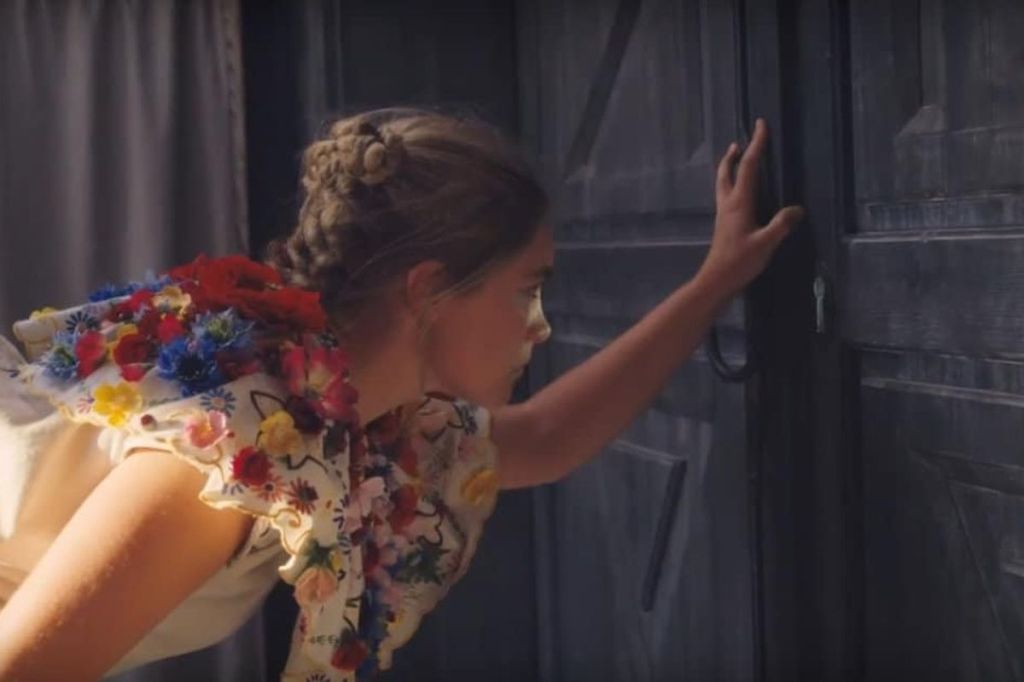
Written and directed by Ari Aster
Starring Florence Pugh, Jack Reynor, William Jackson Harper, Will Poulter, Vilhelm Blomgren
I don’t fully know what to think of Ari Aster’s Midsommar, I really don’t. It’s a slow moving horror with few edits, and a lot of actors acting out entire scenes from a single shot. It’s filmed exactly like Hereditary, his previous film, which I did not like, but I admitted that Aster had an eye for the camera, and was certainly a visionary. And I specifically stated that his next movie would be the one I want to see. I can at least say Midsommar is a better film than Hereditary for my money, because this time around I didn’t leave bored and feeling cheated. Hereditary made me want to leave the theater, and by the end I was livid that I spent 2 hours just to watch a well made film shamelessly rip off two better ones. Aster even said four or five of his all time favorite films are Polanski’s, but that does not excuse how the line of homage and plagiarizing was blurred for Rosemary’s Baby and The Witch. I watched interviews with him afterwards, and he seems like a genuinely humble guy, so maybe I can give him a pass since it was his debut. But despite how great looking it was, and the amazing lead performance by Toni Collette, I was still bored to tears, and not scared. Midsommar did scare me big time in a few scenes, and the music and sound design kept my anxiety high and my interest piqued. But let’s talk about the rest of it all.
It opens like a folk tale, on shot of a painting of festivities, the music joyous. The transition to the real world shows a dark one, but is interrupted loudly by a phone ringing. I jumped outta my seat. The voicemail is left by Dani for her parents, who is distraught at a morbidly cryptic email sent by her sister. She’s worried about her mental health since she’s bipolar. Then she calls her boyfriend Christian, who’s out with his friends. They’re particularly annoyed that he hasn’t cut things off with her despite how noticeably toxic their relationship is.
These opening scenes do not shy away from the pain of deteriorating human emotion and fragility. Dani has a lot of panic attacks, Aster never cuts away from them. In fact both his films are about these things. He focuses on mental illnesses and expressions of all those ailments. You’ll find some hard to sit through, but not as hard as Hereditary’s outbursts. Man, I HATED that Peter kid. But I didn’t hate any character in this movie. They make sense. They aren’t cringe.
The actors are all really good. Christian’s friends are unique grad students who all could be people we know. Mark is blunt, looking for a good time, and hates Dani the most. Josh is studious, very seriously so about his thesis paper, and loves hand writing notes for research. And there’s Pelle, their European hippie friend, who seems too laid back to be real. Dani finds out in passing that they were all planning a trip to Sweden that she had no knowledge of. Christian decides to lie to her that she’s welcome to come. And he lies that his friends want her to come. Christian isn’t such a good guy.
There’s a great cut to them flying to Sweden, where it is Pelle’s family that is hosting a midsummer celebration. It turns out to be some sort of Pagan cult, with the main ritual happening once every 90 years. Here we go.
The intro to this community is blissful, the shadowy lighting that occupied most of the movie thus far finally has disappeared into the bleached out whites we’ve seen in all the marketing. I was surprised how deep into the movie it is before we arrive here. And I love the decision to have these brights, at times blinding lighting in a horror movie. Its syncs perfectly with the deceptive peacefulness and joy the community gives off. But we all know nothing good will come of this, it wouldn’t be a horror movie if it did. The visuals blur from time to time because, oh right, I forgot to mention everyone is on psychedelic trips. A lot. From shrooms and tainted drinks. I’m sure there is less time these people are sober than they aren’t.
There’s a lot about culture in here. Pelle introduces his friends as “Americans”. The Swedish cult does not have any phones or internet, they do everything together, and everyone seems to be on the same creepy page. And they are all happy, only upset at times when their rituals are interfered with by our American leads. This is all a contrast to the American values the film focuses on, and how miserable and separated we are. Dani doesn’t stop having panic attacks, and there is so much miscommunication among relationships. Even at the beginning, Dani worries that she sends 3 emails to her sister and still hasn’t heard back. Who spams emails? Christian and her stay together even though everyone, including them, knows they shouldn’t. He obviously doesn’t know to communicate. Then there’s also the trouble of the thesis, which the movie has made clear Josh will make his on the cult. But Christian, in a scene of total narcissism, tells him he has decided to make his thesis about the same thing, but completely his own idea. The American characters do not ever talk about things openly when they cross their mind. Rather, they bottle them up and hide their real intentions. Most of the scenes have them doing or not doing things because they lack the ability to communicate their real wants. That sort of problem has been eliminated in the community they now find themselves trapped in. Another couple from London is there too, and when there is complications with them exiting, Christian even says, “Maybe there was a miscommunication”.
There are moments of extreme violence in Midsommar. They are very quick though, and not lingered on. The movie more so excels in its disturbing imagery and ideas. The drawings, the rituals, the yellow pyramid house, and the bear. I felt the slow burn of most of this, and somehow I wasn’t bored. I’m not sure Midsommar accomplishes everything it sets out to, but it for sure succeeds more than Hereditary did. Florence Pugh gives a painful and real performance as Dani, and is more authentic as a manic depressant always suffering.
Just like Hereditary, the camera usually hovers slowly around the actors and plays as witness to the horrific events. Aster loves that slow revolving pan shot, and he loves playing out whole dialogue scenes from one angle. Later on the camera moves in and out with the characters, and keeps us well versed on where we are. I never felt out of place or disoriented. The strangest thing of all is that I liked all the scenes before they even get to Sweden the most. I liked this real look at tragedy (that double murder suicide, what the fuck), I liked the patient pacing. I liked that it took time with our leads before the movie even really gets going. I remembered all their names, all their mannerisms, and I cared about them. Even though they could be borderline annoying, I wanted to know what would happen to each of them. I wanted to see where the movie goes.
By the end you won’t really be shocked or unable to tell what the conclusion will be. There are hints along the way, and after you’ve endured the festival, the ending is just a logical way for the story to go. The American individual and the European community, the divide lends insight to the final minutes. And why one person finally smiles
 Seb Screens It